
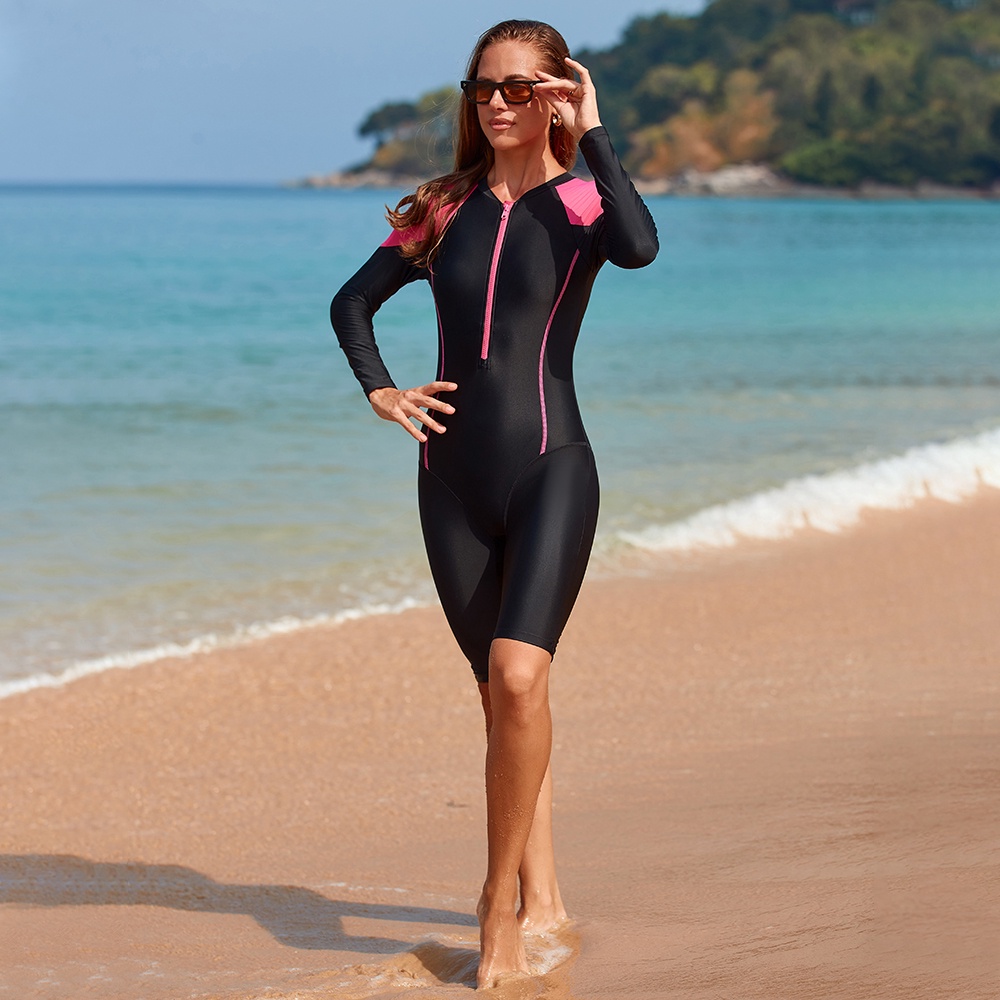
The difference between a swimsuit that sells well all season and one that generates returns and negative reviews often comes down to things the customer can't see in a product photo. Lining quality, elastic recovery, strap attachment reinforcement, and dye lot consistency are invisible in marketing - but they determine whether a customer buys again from your store. Understanding these variables is the most valuable thing a buyer can learn when sourcing swimwear.
Construction Quality: What Separates Mid-Tier from Premium
Mid-tier swimwear usually looks fine on the rack. The differences show up after a few wears - and they have everything to do with construction decisions that aren't visible in product photography.
Elastic quality: Elastic is the most common failure point. Premium swimwear uses woven elastic (wider, more stable when wet) rather than knit elastic. SBART specifies elastic type and width in all product documentation.
Strap attachment: Premium garments use bar-tack reinforcement at strap attachment points. Mid-tier often uses single-pass stitching that can fail under tension. SBART's QC includes bar-tack pull testing on every production run.
Lining quality: The difference between a lining that stays put and one that bunches or rolls is the lining attachment method. Premium construction tacks the lining at side seams and hem; mid-tier often lets the lining float free. Standard bikini tops: removable padding or shelf bra. High-end: fixed contour cups or underwire support. Bottoms: 100% l...
Fabric and Lining: What to Specify and Why
Fabric is the single largest determinant of swimwear quality. The composition ratio of nylon to spandex, the weight of the fabric, the type of lining, and the elastic recovery all directly affect how the garment performs in use - and how long it stays in a customer's wardrobe.
Standard fabric: Most bikinis use 80-82% nylon with 18-20% spandex for stretch recovery. Premium lines add elastane coating for shape retention. Recycled nylon (regenerated nylon fiber) is increasingly popular as a sustainability option.
Lining specifications: Standard bikini tops: removable padding or shelf bra. High-end: fixed contour cups or underwire support. Bottoms: 100% lined front/back in quality construction.
Construction details: Check: elastic recovery at leg openings (40-50% stretch minimum), strap attachment reinforcement (double-stitched preferred), and metal hardware corrosion rating for clasps/sliders.
For U.S., UK, Australia, Canada buyers: specify these in your tech pack. A manufacturer who can show you fabric spec sheets with exact weights, compositions, and test data is more reliable than one who describes quality in general terms. SBART provides spec sheets for all fabrics used in our production.
Swimwear Categories and Their Target Audiences: Surf Bikini, Red Bathing Suit, and Beyond
Each swimwear category serves a distinct customer segment, and matching the right product type to the right audience is the foundation of successful inventory planning.
Bikinis appeal to a broad age range (18-45), with fit variety (triangle, high-leg, high-waist, Brazilian) driving most purchase decisions. Mix-and-match capability is a conversion driver.
Tankinis are strongest in the 30-55 demographic, particularly among customers who want coverage with convenience. The ability to buy different top and bottom sizes is a major differentiator.
One-pieces cross generations but are strongest in two groups: under-25 fashion-forward buyers (cut-out, plunge, monokini styles) and 35+ customers seeking tummy control, full coverage, or athletic fits.
Men's swimwear is driven by inseam length preference (short: 5″ for modern; 7″ for classic) and fabric performance (quick-dry polyester dominates).
For the Surf Bikini category specifically, SBART's market data shows the strongest growth in the Red Bathing Suit and Long Sleeve One Piece Swimsuit segments. The Mens Swim Briefs and Mid Rise Bikini Bottoms categories represent emerging areas worth testing in limited quantities.
How to Evaluate a Swimwear Manufacturer Before Committing
The decision to partner with a swimwear manufacturer is one of the most consequential a brand or retailer can make. A good partnership compounds in value with every season; a bad one creates problems that extend far beyond the first order.
Evaluating a potential manufacturer:
- Request and review written spec sheets. Vague descriptions ('quality fabric') are a red flag - real manufacturers specify fiber content, weight, and elastic type.
- Ask for defect rate data and QC documentation. If they don't track defects, they can't manage quality.
- Verify sample-to-production consistency. Request photos of previous production runs alongside the approved sample for the same order.
- Ask about dye lot control. Single-dye-lot production for orders under 500 pieces is the standard SBART recommends.
- Check communication responsiveness and technical depth in pre-sale conversations. This is the best predictor of problem resolution capability post-sale.
SBART meets all of these criteria and provides documentation to back them up.
SBART Custom Swimwear OEM Services
SBART operates dedicated production capacity for the full range of swimwear, including Surf Bikini styles, Red Bathing Suit lines, and specialty constructions for performance, plus-size, and children's categories.
Our OEM/ODM service covers: specification development, fabric sourcing from certified mills (Oeko-Tex, GRS), sample production with fit review, bulk manufacturing with inline QC inspection, and final packaging with documentation.
For brands and retailers serving U.S., UK, Australia, Canada markets: SBART has established logistics channels and customs compliance documentation for US, EU, UK, Australian, and Canadian import requirements.
Contact SBART to discuss your swimwear requirements. Tell us about the Mid Rise Bikini Bottoms or White Beach Cover Up specifications you're targeting, or describe your customer demographic - our team will recommend a starting configuration for your production run.
Frequently Asked Questions About Swimwear Manufacturing
- How do I ensure color consistency across bikini top and bottom sets? Request single-dye-lot production. SBART tracks dye lot per order and will reject any component that falls outside color tolerance (Delta E < 1.0). This is a standard part of our QC process.
- Should bikinis be fully lined? Quality bikini bottoms are fully front-and-back lined. Tops may use removable padding or no lining depending on style. Minimal lining reduces manufacturing cost but also reduces garment lifespan. SBART spec sheets include lining type explicitly.
- What is the standard fabric composition for quality bikinis? 80-82% nylon, 18-20% spandex for a balanced stretch-to-recovery ratio. Higher spandex content (22-25%) adds compression but reduces breathability. SBART recommends specifying the exact ratio in your tech pack.
- What are the most common quality defects in bikini production? Elastic curling after first wash, strap attachment failure (poor bartack reinforcement), and dye lot variation between tops and bottoms. SBART QC protocol checks all three before shipment.