
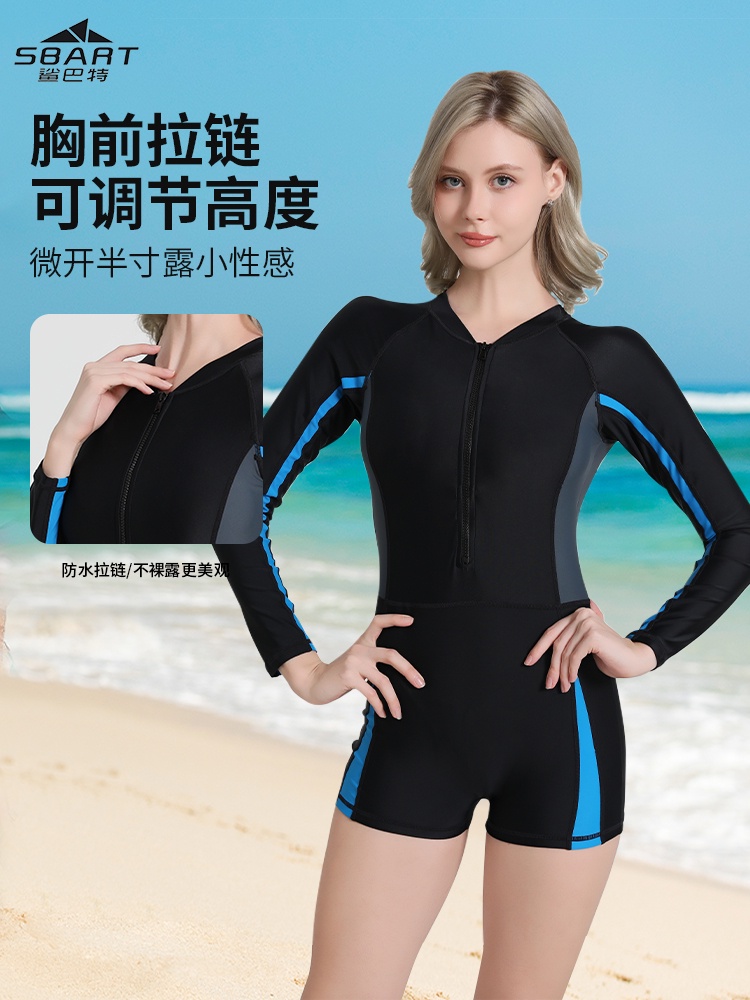
Walk through any swimwear department and the variety can feel overwhelming. Bikinis, tankinis, one-pieces, swim skirts, rash guards - each category serves a different customer profile and has different manufacturing requirements. For a buyer or brand, knowing which product types to stock (and in what proportions) starts with understanding who your customer is and matching the product to their actual needs.
Swimwear Categories and Their Target Audiences: Swimsuit With Shorts, Modest Bathing Suits, and Beyond
Each swimwear category serves a distinct customer segment, and matching the right product type to the right audience is the foundation of successful inventory planning.
Bikinis appeal to a broad age range (18-45), with fit variety (triangle, high-leg, high-waist, Brazilian) driving most purchase decisions. Mix-and-match capability is a conversion driver.
Tankinis are strongest in the 30-55 demographic, particularly among customers who want coverage with convenience. The ability to buy different top and bottom sizes is a major differentiator.
One-pieces cross generations but are strongest in two groups: under-25 fashion-forward buyers (cut-out, plunge, monokini styles) and 35+ customers seeking tummy control, full coverage, or athletic fits.
Men's swimwear is driven by inseam length preference (short: 5″ for modern; 7″ for classic) and fabric performance (quick-dry polyester dominates).
For the Swimsuit With Shorts category specifically, SBART's market data shows the strongest growth in the Modest Bathing Suits and Bathing Suits For Women Over 60 segments. The Ladies Swim Shorts and Chlorine Resistant Swimsuits categories represent emerging areas worth testing in limited quantities.
Swimwear Sizing: What Every Buyer Should Know
Sizing inconsistency is the leading cause of swimwear returns across all categories. The problem: even within a single brand, grading consistency between sizes can vary significantly between production runs.
Key sizing rule: Measure-based sizing beats generic S/M/L/XL every time. The most important measurements for swimwear are: bust (plus cup size for one-pieces and tankinis), waist (narrowest point), hip (widest point), and torso length (shoulder to crotch, front - critical for one-pieces).
US bikini sizing typically uses dress size parity (S=4-6, M=8-10, L=12-14). SBART recommends requesting graded size charts from your manufacturer to verify consistency across the size run.
SBART recommends: include a measurement-based size chart in your product listings. It directly reduces return rates. Our grading process uses laser-scanned pattern verification across all sizes for consistency.
Fabric and Lining: What to Specify and Why
Fabric is the single largest determinant of swimwear quality. The composition ratio of nylon to spandex, the weight of the fabric, the type of lining, and the elastic recovery all directly affect how the garment performs in use - and how long it stays in a customer's wardrobe.
Standard fabric: Most bikinis use 80-82% nylon with 18-20% spandex for stretch recovery. Premium lines add elastane coating for shape retention. Recycled nylon (regenerated nylon fiber) is increasingly popular as a sustainability option.
Lining specifications: Standard bikini tops: removable padding or shelf bra. High-end: fixed contour cups or underwire support. Bottoms: 100% lined front/back in quality construction.
Construction details: Check: elastic recovery at leg openings (40-50% stretch minimum), strap attachment reinforcement (double-stitched preferred), and metal hardware corrosion rating for clasps/sliders.
For U.S., UK, Australia, Canada buyers: specify these in your tech pack. A manufacturer who can show you fabric spec sheets with exact weights, compositions, and test data is more reliable than one who describes quality in general terms. SBART provides spec sheets for all fabrics used in our production.
Swimwear Sourcing Checklist for Brands and Retailers
Before placing your next swimwear order, SBART recommends running through this checklist to minimize the risk of quality issues, sizing problems, or delivery delays:
- Tech pack complete? - Include fabric spec (composition, weight, supplier), lining spec, thread/elastic spec, trim details (zippers, clasps, adjusters), and size chart with grading rules.
- Pre-production sample approved? - Never skip this step. A photo approval is not enough - you need to touch and test the sample.
- Lead time confirmed? - Account for: fabric sourcing (5-10 days), sample production (7-14 days), approval (3-5 days), bulk production (20-30 days), QC and packaging (5-7 days), and shipping (10-30 days depending on origin).
- Certifications verified? - Fabric certifications (Oeko-Tex, GRS), safety compliance (children's drawstring regs, flammability), and label accuracy.
SBART provides a Sourcing Checklist document for all new clients - ask for it when you contact our team.
SBART Custom Swimwear OEM Services
SBART operates dedicated production capacity for the full range of swimwear, including Swimsuit With Shorts styles, Modest Bathing Suits lines, and specialty constructions for performance, plus-size, and children's categories.
Our OEM/ODM service covers: specification development, fabric sourcing from certified mills (Oeko-Tex, GRS), sample production with fit review, bulk manufacturing with inline QC inspection, and final packaging with documentation.
For brands and retailers serving U.S., UK, Australia, Canada markets: SBART has established logistics channels and customs compliance documentation for US, EU, UK, Australian, and Canadian import requirements.
Contact SBART to discuss your swimwear requirements. Tell us about the Chlorine Resistant Swimsuits or Cheap Bikinis specifications you're targeting, or describe your customer demographic - our team will recommend a starting configuration for your production run.
Common Swimwear Questions From Retailers
- Should bikinis be fully lined? Quality bikini bottoms are fully front-and-back lined. Tops may use removable padding or no lining depending on style. Minimal lining reduces manufacturing cost but also reduces garment lifespan. SBART spec sheets include lining type explicitly.
- How do I ensure color consistency across bikini top and bottom sets? Request single-dye-lot production. SBART tracks dye lot per order and will reject any component that falls outside color tolerance (Delta E < 1.0). This is a standard part of our QC process.
- What are the most common quality defects in bikini production? Elastic curling after first wash, strap attachment failure (poor bartack reinforcement), and dye lot variation between tops and bottoms. SBART QC protocol checks all three before shipment.
- What is the standard fabric composition for quality bikinis? 80-82% nylon, 18-20% spandex for a balanced stretch-to-recovery ratio. Higher spandex content (22-25%) adds compression but reduces breathability. SBART recommends specifying the exact ratio in your tech pack.